

Table of Contents
- The Real Cost of Commercial Painting: What You’re Actually Paying For
- Labour, Materials and Everything In Between
- Commercial Painting Cost Per Square Metre: How to Read a Quote
- The Hidden Costs of DIY Commercial Painting Nobody Talks About
- Benefits of Hiring Professional Painters for Business: More Than a Fresh Coat
- How Paint Grade and Preparation Affect Long-Term Durability
- Commercial Painting Project Duration: What Determines Your Timeline
- Calculating the ROI: When Professional Painting Pays for Itself
- Frequently Asked Questions
Last Updated: September 30, 2026
The Real Cost of Commercial Painting: What You’re Actually Paying For
Commercial painting is the process of preparing and coating the interior or exterior surfaces of a business property, from retail shopfronts to warehouses and offices. It costs more than residential work because of access equipment, after-hours scheduling, and surface preparation on a larger scale. At We Do Painting, we quote commercial jobs across Melbourne every week, and the same question comes up almost every time: is professional commercial painting worth the cost, or can you save money doing it yourself?
Here’s the short answer. A cheap quote usually means less preparation, thinner paint, and a shorter lifespan. That’s not a sales pitch, it’s just how coatings work.
Below, we’ll break down what you’re actually paying for, where DIY costs hide, and how to work out whether the professional route pays for itself.
Labour, Materials and Everything In Between
Every commercial painting quote comes down to three buckets: labour, materials, and access.
Labour is the biggest line item, and it’s labour-intensive by nature. Surface preparation, masking, cutting in, and clean-up all take time. A common mistake is comparing quotes on the paint price alone. Two quotes can use identical paint and still differ by thousands, because one includes proper preparation and the other doesn’t.
Materials cover paint, primers, fillers, and consumables. Specialised coatings for high-traffic or industrial areas cost more upfront but last longer.
Access is the quiet cost driver. Height, scaffolding, boom lifts, and protecting stock or equipment all add to the job.
Ask any painter to itemise the prep work separately in their quote. If they can’t, they’re either guessing or planning to skip it.
Commercial Painting Cost Per Square Metre: How to Read a Quote
Commercial painting cost per square metre is a useful comparison tool, but only when you know what’s included. Many businesses find that a lower square metre rate simply means fewer coats, minimal surface preparation, and no protective covering for floors or fittings.
When you compare quotes, check these four things:
- Coats and products: How many coats, and which paint system?
- Preparation: Filling, sanding, and priming included or extra?
- Protection: Are floors, furniture, and stock covered?
- Access: Is equipment hire built into the price?
A square metre rate with no context tells you almost nothing. Ask what the rate covers before you treat it as a like-for-like number.
The Hidden Costs of DIY Commercial Painting Nobody Talks About
DIY painting looks cheaper on paper and rarely is in practice. The savings evaporate once you count the real costs.
First, there’s business downtime. Every hour you or your staff spend painting is an hour not spent on revenue. Second, there’s the equipment: rollers, brushes, masking materials, ladders, and possibly a spray unit. Third, there’s rework. A poor surface preparation job leads to peeling, blistering, and a full repaint far sooner than expected.
Then there’s the risk. If a staff member is injured on a ladder, or paint damages a customer’s vehicle in the car park, you’re carrying that exposure. A professional painter brings their own insurance and workplace safety practices to the job.
The DIY saving is real only if your time is worth nothing and nothing goes wrong.
Benefits of Hiring Professional Painters for Business: More Than a Fresh Coat
The benefits of hiring professional painters for business go well beyond appearance. A professional finish protects your asset, reduces maintenance frequency, and keeps your doors open while the work happens.
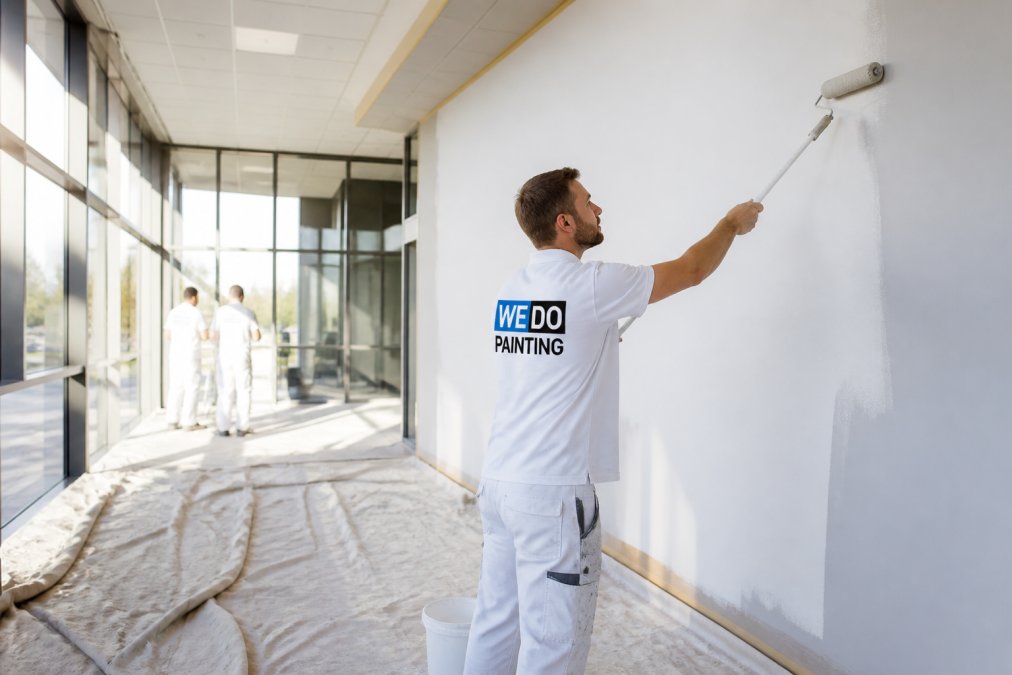
Three practical advantages stand out:
- Operational efficiency: A crew can work after hours or in stages, so your business keeps trading.
- Asset protection: Correct preparation and coating prevent moisture damage and premature deterioration.
- Compliance: Professionals understand their obligations on commercial sites.
Compliance, Insurance and Liability on Commercial Sites
Commercial sites carry obligations that home painting doesn’t. Work health and safety duties apply to anyone working on your premises, and Safe Work Australia sets out the framework that governs them. If a contractor is injured on your site, or their work damages property, the liability question matters.
A professional painter should carry public liability insurance and provide a certificate of currency on request. This is one of the clearest reasons professional commercial painting is worth the cost: you’re not just buying paint, you’re buying reduced risk.
Hiring an uninsured painter to save money can leave you exposed if someone is injured on your site or a neighbouring property is damaged. Always ask for proof of insurance before work starts.
How Paint Grade and Preparation Affect Long-Term Durability
Paint grade and surface preparation decide how long a finish lasts, and both are where cheap jobs cut corners. Industrial grade and specialised coatings cost more per litre but resist scuffing, moisture, and cleaning far better than standard interior paint.
Preparation matters just as much. Paint adheres to clean, sound surfaces.
| Environment | Coating Priority | Why It Matters |
|---|---|---|
| Retail shopfront | Scuff and wash resistance | High foot traffic and frequent cleaning |
| Warehouse or factory | Industrial grade durability | Machinery, chemicals, and abrasion |
| Office interior | Low odour, fast recoat | Minimal disruption to staff |
| Heritage property | Surface-compatible systems | Older substrates need specific products |
Commercial Painting Project Duration: What Determines Your Timeline
Commercial painting project duration depends on four things: total surface area, surface condition, access requirements, and how many hours per day the site is available.
The fastest way to slow a project down is to skip preparation. Fixing surface defects mid-job adds more time than doing it properly upfront.
Calculating the ROI: When Professional Painting Pays for Itself
Most quote comparisons stop at the invoice. The number that actually decides whether professional commercial painting is worth the cost is total cost of ownership over the life of the finish. Here is how to build it.
The total cost of ownership formula
Total cost of ownership = upfront price + (number of repaints × cost per repaint) + downtime cost per repaint × number of repaints
- Quote A, $18,000. Two coats of a standard interior product over minimal preparation. Expect a repaint in roughly three years.
- Quote B, $26,000. Full preparation, primer, and an industrial-grade coating. Expect a repaint in roughly seven years.
The variables that move the answer
Three inputs decide whether the professional route wins on total cost:
- Repaint interval. This is driven almost entirely by preparation and coating grade, not by the painter’s hourly rate. A well-prepared surface with a commercial-grade coating can realistically double the interval between repaints.
- Downtime cost per day. A retail shopfront losing a Saturday of trade is a very different number from a warehouse that can paint around operations. The higher your downtime cost, the more the longer-interval option wins.
- Access cost per repaint. Scaffolding and boom lift hire are paid again at every repaint. Fewer repaints means fewer access mobilisations.
The tax treatment: repair or capital improvement?
The tax angle is where the ROI calculation gets genuinely useful, and where most quote comparisons ignore it entirely.
Broadly, the Australian Taxation Office distinguishes between:
- Repairs, restoring an asset to its previous condition, such as repainting a wall that has worn or faded. For a commercial property held as an income-producing asset, repairs are generally deductible in the year they are incurred.
- Capital improvements, work that improves the asset beyond its original condition or is part of a larger renovation. These are generally treated as capital works and deducted over time under the capital works provisions, rather than claimed in full upfront.
The professional quote is not automatically the cheaper option over time, but the comparison only becomes meaningful once you add repaint frequency, downtime, access costs, and the tax treatment of the work. Run the formula before you decide, not after.
A quick way to sanity-check any quote
Ask each painter two questions: how many years do you expect this finish to last in this environment, and what preparation and coating system are you using to get there? If the answers are vague, the quote is not comparable. If they are specific, you have the inputs you need to run the total cost of ownership calculation and make the call on evidence rather than on the lowest number.
Frequently Asked Questions
Is hiring a professional commercial painter worth the investment?
For most commercial properties, yes. Professional commercial painting covers thorough surface preparation, correct product selection for the environment, and compliance with workplace safety and insurance requirements. The finish lasts longer, which reduces how often you need to repaint. When you factor in avoided downtime, reduced risk, and the potential tax treatment of painting as a capital improvement, the upfront cost often delivers better value than a cheaper DIY attempt that fails within a few years.
What do painters charge per hour in Australia?
Hourly rates for commercial painters vary by region, project complexity, and the painter’s experience. Rather than quoting a single figure, most commercial painting contractors price work by square metre rate or as a fixed project quote. This approach accounts for surface preparation, access requirements, and the number of coats needed. Ask for a detailed breakdown showing labour costs, materials, and preparation separately so you can compare quotes on equal terms.
Does professional painting include surface preparation and repairs?
A proper commercial painting quote should always include surface preparation. This covers cleaning, sanding, filling cracks, patching holes, and priming bare or repaired areas. Skipping or minimising prep is the most common reason paint peels or blisters within a few years. If one quote is significantly cheaper than others, check whether preparation and minor repairs are included or listed as exclusions. Ask the contractor to specify exactly what prep work is covered before you sign.
How long should a professional commercial paint job last?
A well-prepared and correctly applied commercial paint job typically lasts seven to ten years on interior surfaces and five to seven years on exterior surfaces, depending on exposure, substrate, and paint quality. Industrial-grade or specialised coatings can extend that further in high-wear environments. The biggest factor is preparation quality. Surfaces that were properly cleaned, repaired, and primed before painting consistently outlast those given a quick recoat.