

Table of Contents
- Why Industrial Coating Maintenance Matters for Warehouse Operations
- Understanding Protective Coating Systems in Warehouses
- Surface Preparation and Substrate Analysis for Long-Term Asset Integrity
- Industrial Floor Coating Repair: Identifying and Addressing Damage
- Industrial Painting Maintenance Schedule: Timing and Frequency
- OHS Requirements for Warehouse Flooring and Safety Compliance
- Cost-Benefit Analysis: Maintenance Versus Replacement
- Conclusion
- Frequently Asked Questions
Last Updated: September 4, 2026
Why Industrial Coating Maintenance Matters for Warehouse Operations
Warehouse floors and structural steel endure forklift traffic, chemical spills, and constant abrasion that compromise the facility if left unprotected. Industrial coating maintenance is the systematic process of inspecting, repairing, and recoating these protective systems to preserve structural integrity and operational safety.
The cost of neglecting this maintenance compounds quickly. A small crack in a floor coating allows moisture and chemicals to penetrate the substrate, which can lead to concrete spalling and costly structural repairs. Similarly, corrosion on structural steel weakens load-bearing capacity over time. According to guidance on protective coating standards and asset preservation, the primary purpose of any coating system is to act as a sacrificial barrier, protecting the underlying asset from atmospheric conditions and operational wear.
A modest annual maintenance budget prevents six-figure replacement projects. This guide covers coating systems, inspection methods, and maintenance scheduling to keep your facility operational and compliant.
Understanding Protective Coating Systems in Warehouses
The right coating system depends on traffic levels, atmospheric conditions, and chemical resistance requirements. Most warehouses use floor coatings and structural steel protection specified for distinct roles.
Epoxy and polyurethane coatings
Epoxy flooring bonds densely to concrete, resists chemicals, and withstands forklift abrasion. A full system includes primer, body coat, and topcoat applied at controlled thickness for durability.
Polyurethane coatings provide UV and temperature resistance with superior slip resistance. Many facilities combine epoxy base with polyurethane topcoat.
Anti-corrosion and structural steel protection
Structural steel requires anti-corrosion protection to prevent rust in humid or chemically active environments. Abrasive blasting is the standard surface preparation method to achieve proper coating adhesion.
Surface Preparation and Substrate Analysis for Long-Term Asset Integrity
The biggest mistake in industrial painting is skimping on surface preparation. Paint adhesion fails when the substrate is contaminated, damp, or improperly profiled. Substrate analysis must confirm concrete is dry, sound, and free of oils or loose coatings.
Moisture control is critical for concrete floors; rising vapour causes blistering and delamination. Steel must be abrasive blasted to remove rust and mill scale, creating the anchor pattern for primer adhesion.
Industrial Floor Coating Repair: Identifying and Addressing Damage
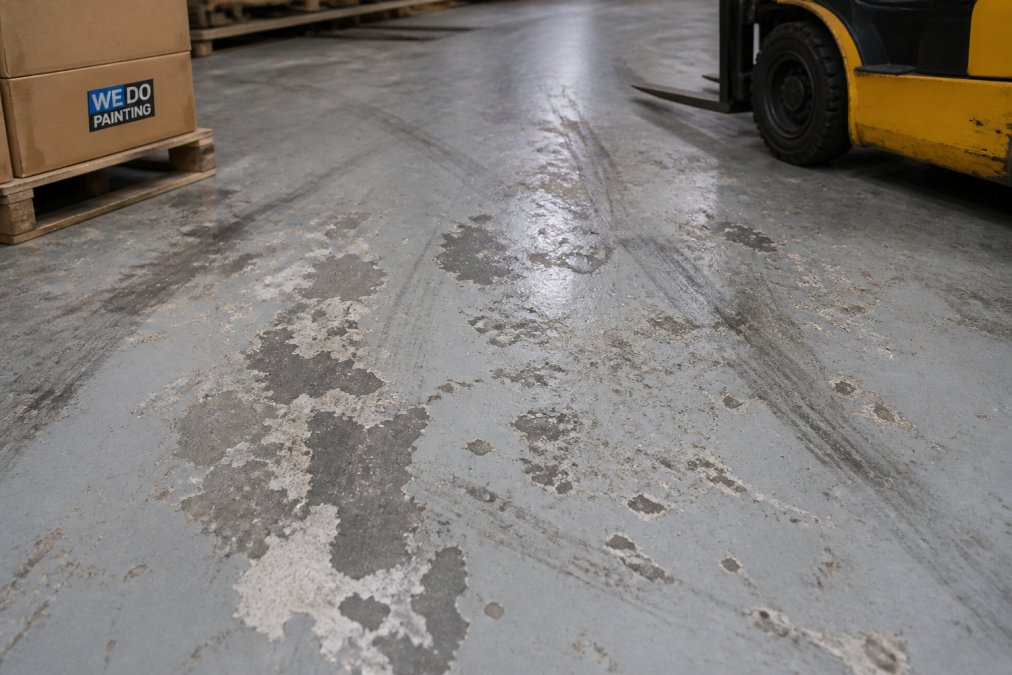
Early damage detection controls costs. Small chips expand rapidly under traffic, allowing moisture and chemical attack. Understanding severity allows prioritisation and avoids unnecessary full-floor replacements.
Common signs of coating degradation and severity assessment
Minor damage (repair within 3-6 months):
- Wear patterns: Visible thinning in forklift aisles and turning zones; coating remains intact but indicates high-traffic zones needing attention before failure.
- Hairline cracking: Surface cracks narrower than 1 mm from thermal cycling or minor impact; will widen if unaddressed.
- Isolated chips or small blisters: Localised lifting or breakage affecting less than 5% of a zone.
Moderate damage (repair within 1-3 months):
- Delamination: Large flakes lifting from concrete due to moisture or poor adhesion. If affecting 5-20% of a zone, strip and recoat before moisture penetrates deeper.
- Chemical staining or softening: Discolouration or tackiness from spills. Test by pressing a fingernail into the surface; if the coating yields, chemical penetration has weakened the binder.
- Visible efflorescence: Whitish, powdery residue indicating moisture migration and failed moisture barrier.
Severe damage (repair within 1 month or isolate the area):
- Widespread delamination: Flaking affecting more than 20% of a zone or actively spreading under traffic.
- Concrete spalling: Concrete substrate breaking apart into pits or rough edges; structural integrity is compromised and must be repaired immediately.
- Moisture breakthrough: Wet concrete or visible water pooling, indicating complete moisture barrier failure.
Step-by-step inspection and severity grading checklist
- Prepare the inspection zone: Clear traffic and sweep clean. Document date, time, and ambient humidity.
- Inspect high-traffic areas first: Aisles, loading docks, and turning zones show damage earliest. Photograph from consistent angles for comparison.
- Check for moisture: Look for efflorescence, damp patches, or musty smell. Use a moisture meter; readings above 4% indicate rising damp.
- Perform the hammer tap test: Tap suspect areas with a rubber mallet; hollow sounds indicate delamination. Mark with chalk or tape.
- Measure coating thickness: Use a coating thickness gauge to confirm specification. Most warehouse epoxy systems are 200-300 micrometres; below 150 indicates advanced wear.
- Assess crack width and pattern: Measure cracks with a gauge or ruler. Cracks wider than 2 mm or forming patterns suggest structural movement requiring investigation.
- Grade the severity: Assign each zone a severity score (1-3) based on damage types and percentage affected.
- Document findings: Record photos, measurements, severity grades, and location in a maintenance log. This log guides repair scheduling and budgeting.
Prioritisation framework for multi-zone facilities
Prioritise repairs in large warehouses using this framework:
- Tier 1 (immediate): Severe damage in high-traffic zones; actively failing and posing safety and substrate damage risks.
- Tier 2 (within 3 months): Moderate damage in high-traffic zones or severe damage in low-traffic zones; stable but will deteriorate if deferred.
- Tier 3 (within 6 months): Minor damage in any zone or moderate damage in low-traffic areas; bundle into planned cycles.
Industrial Painting Maintenance Schedule: Timing and Frequency
A planned maintenance schedule extends asset longevity and allows you to manage downtime rather than react to failures.
Preventative maintenance intervals
Full recoating cycles for warehouse floors typically occur every five to seven years, with annual spot repairs in high-traffic areas. Structural steel should be inspected every two years for early corrosion signs.
Managing facility downtime during maintenance
The biggest operational concern for facility managers is disruption. Coating work requires the floor to be clean, dry, and out of service for a set period. The solution is phasing: divide the floor into zones and complete the work in sections so that warehouse operations continue in the rest of the building. This approach to industrial maintenance scheduling and downtime reduction keeps your logistics facility productive while the protective work proceeds.
OHS Requirements for Warehouse Flooring and Safety Compliance
Workplace health and safety obligations in Australia place a clear duty on facility owners to maintain a safe environment. Under model work health and safety regulations, flooring that is uneven, slippery, or deteriorating can constitute a hazard.
Industrial coating maintenance ensures OHS compliance. Worn coatings create trip hazards and expose concrete to progressive damage. Safety markings and anti-slip additives in topcoats maintain separation of people and machinery.
Ignoring worn or damaged floor coatings is not just a maintenance issue. It creates a documented trip hazard that could expose the business to liability under Australian WHS laws if an incident occurs.
Cost-Benefit Analysis: Maintenance Versus Replacement
Preventative maintenance requires concrete financial justification. The following framework quantifies the cost of inaction versus scheduled maintenance investment.
Scenario comparison: Reactive versus preventative approaches
Scenario 1: Reactive approach (no planned maintenance)
A 2000 m² warehouse floor neglected for 10 years develops minor damage in year 3. By year 7, delamination compromises 30% of the floor. Spalling begins in year 8. By year 10, the floor is unsafe and must be replaced.
- Full floor replacement: Pricing depends on the specific requirements of the project.
- Operational downtime (4-6 weeks): Significant costs due to business interruption.
- Emergency repairs: Additional costs for urgent, unplanned work.
- Total: Costs are substantially higher than a preventative approach.
Scenario 2: Preventative maintenance approach
The same 2000 m² floor is inspected annually with minor repairs within 3 months. Phased recoating of high-traffic zones occurs every 5 years. The floor remains in service.
- Annual inspection and minor repairs: Costs depend on the scope of work.
- Phased recoating (years 5 and 10): Costs depend on the scope of work.
- Total over 10 years: Significantly lower than a reactive approach.
- Downtime: Minimal, often allowing the facility to remain operational.
Key cost drivers in the maintenance decision
1. Substrate repair costs
Spalling repair costs escalate dramatically. Small areas cost less to repair than large zones. Early repair prevents more extensive and costly damage.
2. Operational downtime and lost throughput
For 24/7 facilities, downtime has direct cost. Phased maintenance keeping operations running minimises lost throughput.
3. Coating system lifespan and recoating intervals
High-quality epoxy systems last 7-10 years under heavy traffic; polyurethane topcoats extend this to 10-12 years. Full recoating is a significant investment. If the floor fails, substrate repair costs can be much higher. Budget for recoating every 7 years; the alternative is full replacement at a much higher cost.
ROI calculation for a typical warehouse
For a facility manager presenting a maintenance budget to leadership, this calculation is useful:
Investment: Costs vary based on the specific needs of the facility.
Benefit: Avoiding full replacement and lost throughput results in substantial cost savings.
ROI: Significant return on investment over the long term, excluding continuous operations, safety, and liability benefits.
The most expensive coating is the one applied twice because the surface was not prepared correctly the first time, or the one that fails prematurely because maintenance was deferred. Budget for proper surface preparation, annual inspections, and phased recoating on a 5-7 year cycle. The upfront cost is significantly lower than the cost of reactive replacement, and the operational benefit is immeasurable.
Conclusion
Protecting a warehouse asset requires year-round discipline: regular inspections, correct surface preparation, and phased recoating preserve structure and operational uptime.
For facility managers in Melbourne seeking industrial maintenance expertise, We Do Painting offers comprehensive services across residential, commercial, and industrial sectors, led by Matthew Chawulak, delivering projects on time and on budget.
Get started with We Do Painting and request a quote to protect your facility for the long term.
Frequently Asked Questions
What is the difference between industrial coating maintenance and standard warehouse painting?
Industrial coating maintenance focuses on preserving protective systems that guard against corrosion, chemical exposure, and wear rather than aesthetics alone. Protective coatings form a barrier against moisture, UV damage, and atmospheric conditions that degrade structural steel and concrete. Standard painting typically addresses appearance. For warehouses, maintenance involves regular inspection, targeted repairs, and scheduled recoating to extend facility longevity and prevent costly asset degradation.
How often should industrial floor coating repair be scheduled in a high-traffic warehouse?
High-traffic areas typically need inspection every 6-12 months, with repairs undertaken as damage appears. Minor repairs (small chips or wear spots) can be addressed promptly to prevent moisture penetration. Major recoating of heavily trafficked zones may be needed every 3-5 years depending on coating type, foot traffic intensity, and atmospheric conditions. A preventative maintenance schedule prevents emergency downtime and extends the life of your protective system significantly.
What OHS requirements apply to warehouse flooring in our facility?
Work Health and Safety (WHS) legislation in Australia, enforced by state regulators, requires safe working surfaces free from hazards. Warehouse flooring must be slip-resistant, properly maintained, and marked where needed (e.g., forklift lanes, hazard zones). Damaged or degraded coatings that create trip hazards or reduce slip resistance breach compliance. Regular inspection and maintenance of floor coatings is both a safety obligation and an asset preservation strategy. Consult your state’s WHS regulator for specific requirements for your facility type.
Why is surface preparation so critical before applying new industrial coatings?
Poor surface preparation is the leading cause of coating failure. Dust, rust, moisture, and contaminants prevent adhesion, leading to peeling and degradation within 1-2 years. Proper substrate analysis and abrasive blasting remove these barriers, ensuring the coating bonds fully to the substrate. This investment in preparation directly extends coating life by 3-5 years or more, making it far more cost-effective than rushing the job and facing premature recoating.
How can we manage facility downtime during industrial painting maintenance?
Schedule maintenance during low-traffic periods or in sections, allowing partial operations to continue. Communicate timelines clearly with operations teams so they can plan around the work. Many coating systems cure quickly, reducing closure time. Discuss phased approaches with your maintenance provider: coating one section while another operates, or night-shift work for 24-hour facilities. Proper planning and coordination between facility management and the painting contractor minimises disruption while maintaining asset integrity.
What are the main types of protective coatings used in warehouses?
Epoxy coatings offer excellent durability and chemical resistance for high-wear floors. Polyurethane coatings provide superior UV resistance and flexibility, ideal for areas with temperature fluctuations. Anti-corrosion primers and topcoats protect structural steel from rust and moisture. The choice depends on your warehouse environment: moisture levels, chemical exposure, traffic intensity, and atmospheric conditions. A substrate analysis and coating system specification ensure you select the right protective system for your facility’s specific demands.
What should a warehouse coating inspection checklist include?
Inspect for peeling, blistering, chalking, and colour fading, signs of moisture ingress or UV damage. Check for cracks, chips, and wear patterns in high-traffic areas. Test adhesion in suspect spots. Assess moisture levels in the substrate (moisture is a major coating failure cause). Document findings with photos and measurements. Look for chemical stains or spills that may have compromised the coating. A structured checklist ensures consistency, helps prioritise repairs, and provides a record for planning future maintenance and demonstrating regulatory compliance.