

Table of Contents
- Why Commercial Retail Painting Requires a Different Approach
- After-Hours Commercial Painting Services: Pros, Cons and When to Use Them
- Retail Store Painting Timeline: What to Expect Phase by Phase
- Preparing a Retail Store for Professional Painters
- VOC, Odour and Air Quality Management in Occupied Retail Spaces
- Safety, Compliance and Insurance for Commercial Retail Painting
- Choosing the Right Paint Coatings for High-Traffic Retail Environments
- Post-Painting Maintenance: Protecting Your Investment Long-Term
- Frequently Asked Questions
Last Updated: August 31, 2026
Why Commercial Retail Painting Requires a Different Approach
Painting a commercial retail space without disrupting business is fundamentally different from residential or industrial projects. Stock must be protected, customers may still be walking through, and staff need to work safely alongside contractors. The moment a fresh coat of paint starts off-gassing in an enclosed space, you have an air quality problem that no amount of ventilation fans will fix quickly.
The We Do Painting team works with retail clients who’ve experienced poor outcomes: painters showing up during trading hours with no dust sheets, or high-VOC coatings applied in a closed store over the weekend, leaving the space unusable on Monday. These aren’t edge cases, they’re common outcomes when a contractor treats a retail fit-out like a domestic repaint.
Commercial retail painting is the practice of repainting an active retail environment while managing business continuity, safety compliance, and occupant health simultaneously. Done correctly, it’s invisible to your customers. Done poorly, it becomes a crisis.
The core challenge of commercial retail painting isn’t the painting itself. It’s the project management around it: scheduling, safety, air quality, and communication all need to run in parallel.
After-Hours Commercial Painting Services: Pros, Cons and When to Use Them
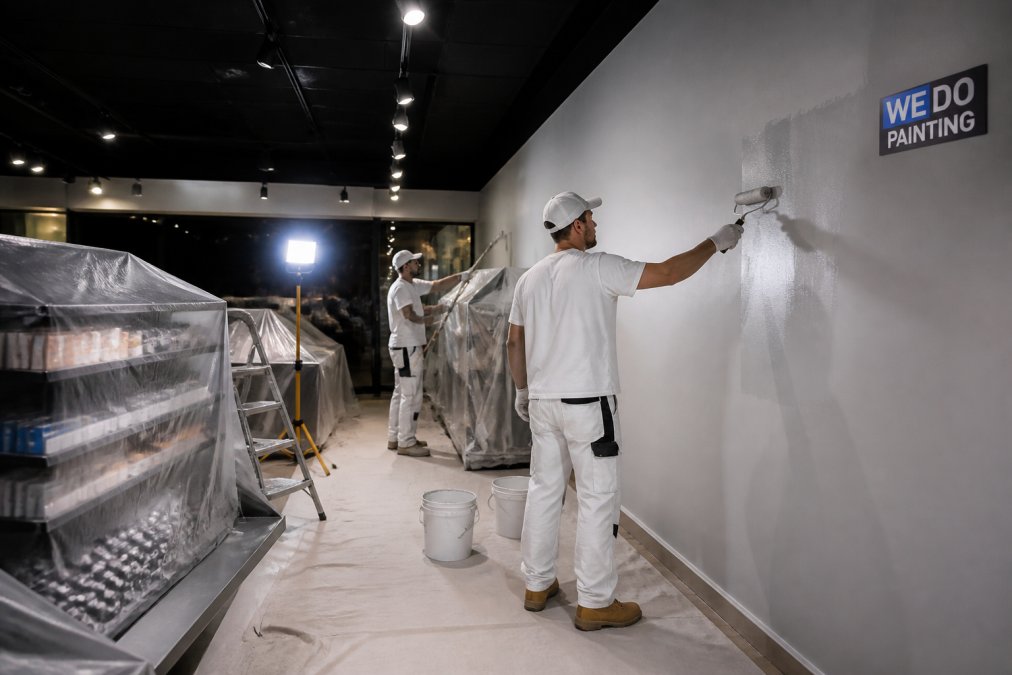
After-hours commercial painting services are the most common solution for occupied retail spaces. Scheduling work outside trading hours removes the biggest variable: people. When painters work overnight or across weekends, the store can trade normally during business hours with no fumes for customers to walk through and no conflict between foot traffic and wet surfaces.
Pros of After-Hours Scheduling
- Zero customer impact. Trading hours remain completely unaffected.
- Faster overall completion. Painters can work across the full floor area without navigating around staff and shoppers.
- Safer for occupants. Paint fumes and dust are largely dissipated before staff arrive, provided adequate ventilation is managed overnight.
- Easier site protection. Fixtures and stock can be covered and left in place rather than moved during trading hours.
- Reduced liability exposure. Fewer people on site during painting means fewer slip, trip, and fume-exposure incidents.
Cons and How to Manage Them
Cost. Night and weekend work attracts penalty rates under the relevant Modern Award for the painting industry, as governed by the Fair Work Act 2009 and applicable Modern Awards. Budget for this from the outset.
Ventilation requirements. Overnight painting in a sealed retail space can allow VOC concentrations to build. Contractors must open loading dock doors, run mechanical ventilation, or use low-VOC coatings to keep air quality within safe limits before staff re-enter. This must be specified in the project scope.
Security and access coordination. After-hours access requires coordination with building management, security systems, and sometimes insurers. Confirm access protocols before the project starts.
Fatigue-related quality issues. A contractor who works nights all week and cuts corners by Thursday is a real risk. Reputable painters schedule night crews with adequate rest cycles.
Retail Store Painting Timeline: What to Expect Phase by Phase
A structured retail store painting timeline is the difference between a project that completes on schedule and one that drags into a second week. Most commercial retail repaints follow three distinct phases.
| Phase | Key Activities | Typical Duration |
|---|---|---|
| Phase 1: Scoping and Scheduling | Site inspection, surface assessment, scheduling plan | 1-3 days |
| Phase 2: Surface Preparation and Protection | Cleaning, patching, masking, covering stock | 1-2 nights |
| Phase 3: Painting and Quality Checks | Primer, topcoats, touch-ups, final inspection | 2-5 nights |
Phase 1: Scoping and Scheduling
A proper scoping visit covers surface condition (existing paint type, adhesion, cracks, moisture), areas requiring plaster repairs or carpentry, access points for after-hours entry, and any pre-existing damage to fixtures. A written condition report before work starts protects both parties if a dispute arises about damage.
Scheduling should account for your trading calendar: avoid starting the week before a major promotional event, and build in a buffer night for unexpected surface issues.
Phase 2: Surface Preparation and Protection
Poor surface preparation is the single most common reason commercial paint jobs fail prematurely. A professional contractor will clean surfaces to remove grease, dust, and contaminants, fill cracks and holes with the correct filler compound, sand back rough areas, and apply primer suited to the substrate.
Simultaneously, the team should lay heavy-duty drop sheets across all flooring, wrap shelving units and display fixtures in plastic sheeting, and tape off power outlets, light fittings, and any surfaces not being painted.
Skimping on surface preparation is the most expensive mistake in commercial painting. If a contractor quotes a significantly lower price by reducing prep time, the paint will fail within two to three years. You’ll pay twice.
Phase 3: Painting and Quality Checks
Painting follows a logical sequence: ceilings first, then walls, then feature elements, then skirting boards and trims. Each coat needs adequate drying time before the next is applied. Quality checks should happen in daylight, not under work lights at 3am, to catch issues that artificial light misses.
Preparing a Retail Store for Professional Painters
Preparing a retail store for professional painters is a shared responsibility. The contractor handles site protection and surface prep; the business owner handles access, stock, and stakeholder communication.
Before the crew arrives:
- Clear or relocate stock near walls. Any product within one metre of a painted surface should be moved or covered.
- Remove or protect signage and artwork. Confirm who is responsible for this in your contract.
- Notify staff and overnight security. Your team needs to know the painters will be on site, and security systems need to be adjusted to allow access.
- Confirm ventilation access. Identify which doors, windows, or mechanical systems can be left running overnight.
- Document existing damage. Walk the space with your contractor before work begins and photograph any pre-existing chips or scratches.
- Brief your property manager. If you’re a tenant, your lease likely requires landlord notification before works. Check your lease and get written approval if required.
Request a written scope of works before the project starts. It should list every surface being painted, the products being used, the number of coats, and the after-hours schedule. This document is your quality benchmark and your protection if anything goes wrong.
VOC, Odour and Air Quality Management in Occupied Retail Spaces
Volatile organic compounds (VOCs) are chemical emissions released by paint as it dries and cures. In an enclosed retail space, high-VOC coatings can reach concentrations that cause headaches, nausea, and eye irritation. Under the Work Health and Safety Act 2011 and Safe Work Australia guidelines, employers have a duty of care to ensure the workplace is safe, which includes managing contractor-generated hazards like paint fumes.
For occupied retail environments, low-VOC or zero-VOC water-based coatings are the practical default. They dry faster, produce significantly less odour, and allow the space to be safely reoccupied within hours rather than days.
Practical air quality management steps include:
- Specifying low-VOC or zero-VOC products in your project scope before signing any contract
- Running mechanical ventilation overnight and for at least two hours after painters leave
- Using VOC monitors to confirm safe levels before staff re-enter
- Avoiding oil-based coatings in enclosed retail spaces unless the surface genuinely requires them
- Scheduling any oil-based work for the start of a long weekend to allow maximum off-gassing time
According to Safe Work Australia’s guidance on hazardous chemicals in the workplace, adequate ventilation is a primary control measure for managing solvent vapours. This is a compliance requirement.
Safety, Compliance and Insurance for Commercial Retail Painting
The safety and compliance dimension of commercial retail painting is where many business owners assume their contractor has it covered. Knowing what to check protects you from liability if something goes wrong on your premises.
What to verify before work starts:
- Public liability insurance. Your contractor should carry a minimum of $20 million public liability cover. Ask for a current certificate of currency.
- Workers’ compensation insurance. If a painter is injured on your premises and the contractor isn’t properly covered, the claim can flow back to you as the property occupier.
- Safe Work Method Statements (SWMS). For any work involving heights above two metres, the contractor must have a documented SWMS under Australian WHS legislation.
- Asbestos awareness. Retail buildings constructed before 1990 may contain asbestos-containing materials. Any surface disturbance requires an asbestos assessment before work begins, as required under the Safe Work Australia model Code of Practice for managing and controlling asbestos.
- Make-good obligations. If you’re a tenant repainting under a make-good clause, confirm the approved colour palette and finish specifications with your landlord in writing before any paint is purchased.
Insurance and liability documentation should be collected and filed before the first painter sets foot in your store.
Choosing the Right Paint Coatings for High-Traffic Retail Environments
Paint selection for commercial retail painting is a technical decision, not an aesthetic one. The right coating must handle customer traffic, frequent cleaning, and the particular demands of the retail environment.
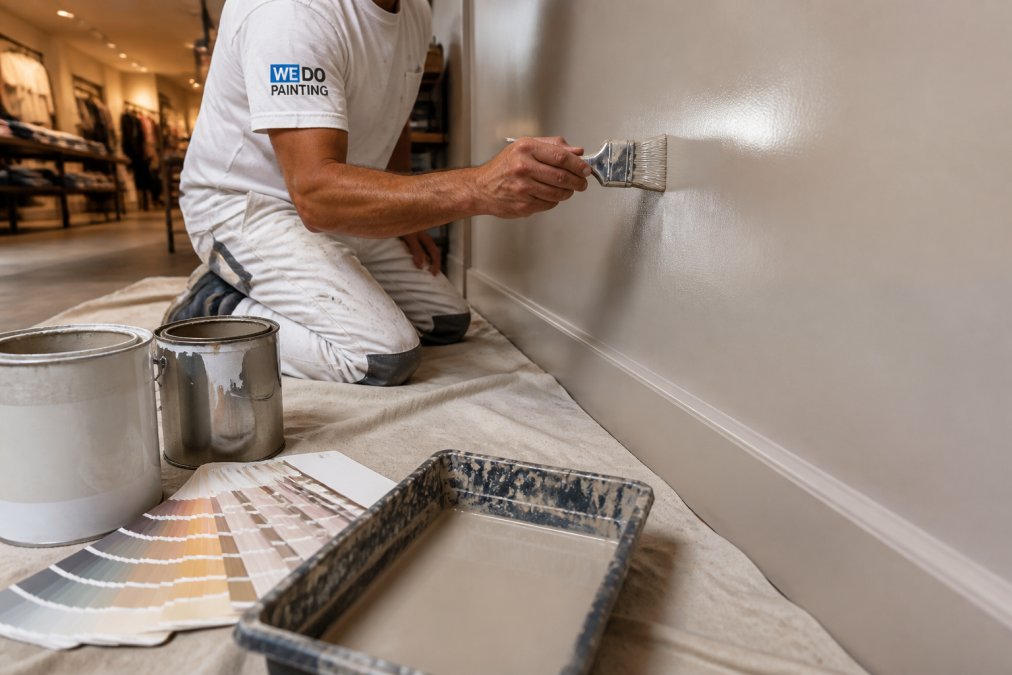
The sheen level is the first decision. Higher sheen finishes are more washable and more resistant to scuffing:
| Surface | Recommended Sheen | Reason |
|---|---|---|
| Feature walls and ceilings | Low sheen or flat | Hides imperfections, not a contact surface |
| Main retail walls | Low sheen or satin | Balances washability with a professional finish |
| Skirting boards and trims | Semi-gloss | Handles knocks and frequent cleaning |
| Service areas and kitchens | Semi-gloss or gloss | Maximum washability, moisture resistance |
| Fitting room interiors | Satin | Durable but not reflective |
Beyond sheen, the substrate matters. Plasterboard walls take water-based acrylics well. Timber trims may benefit from an alkyd-modified water-based product. Concrete or masonry walls in service areas often require a specific masonry coating with anti-fungal properties.
For retail environments where branding consistency matters, specify the exact paint brand and colour code in your project scope to ensure touch-up work years later matches the original application.
Ask your contractor to leave a labelled touch-up tin of every colour used in the project. Store it in a cool, dry location. When a scuff appears in six months, a five-minute touch-up prevents a full repaint.
Post-Painting Maintenance: Protecting Your Investment Long-Term
A freshly painted retail space looks professional and inviting. Keeping it that way over two to five years requires a basic maintenance plan. The most common reason commercial paint jobs deteriorate faster than they should isn’t product quality, it’s the absence of any maintenance routine.
A practical post-painting maintenance schedule:
- Monthly: Wipe down high-contact surfaces with a damp cloth and mild, non-abrasive cleaner.
- Quarterly: Inspect skirting boards, door frames, and feature walls for chips, scuffs, or bubbling. Address these with the touch-up tin before they spread.
- Annually: Conduct a full condition review of all painted surfaces and address any adhesion failure, moisture ingress, or significant wear.
- Every three to five years: Schedule a full commercial retail repaint, depending on traffic levels and cleaning frequency.
The type of cleaning products used on painted surfaces is the factor most businesses overlook. Harsh solvents and abrasive cleaners will strip the paint film over time. Ask your contractor to provide a maintenance guide specific to the products used on your project.
The We Do Painting team provides clients with a written scope of works and can advise on appropriate maintenance practices for the specific coatings applied to your space. Projects are delivered on time and within budget, with high-quality materials and thorough preparation.
Frequently Asked Questions
How do you paint a retail store while it is still open?
The most effective approach is to divide the store into work zones and paint one section at a time, so trading continues in the rest of the space. Combine this with after-hours commercial painting services for the most disruptive tasks, such as ceiling work or areas near the point of sale. Clear signage, dust barriers, and low-VOC paints keep the environment safe and presentable for customers throughout the project.
How long does it take to paint a commercial retail space?
A typical retail store painting timeline depends on floor area, surface condition, and how many hours per day the crew can access the space. A small to mid-size retail tenancy often takes three to seven nights of after-hours work. Larger or multi-level spaces with extensive surface preparation can run two to three weeks. Your contractor should provide a phased project schedule before work starts so you can plan staffing and stock movement accordingly.
What safety standards must commercial painters follow in retail environments?
Commercial painters working in occupied or semi-occupied retail spaces must comply with the Work Health and Safety Act 2011 and Safe Work Australia’s guidance on hazardous work, including working at height and hazardous substances. In Victoria, WorkSafe Victoria oversees compliance. Painters should hold current public liability insurance, provide Safe Work Method Statements for high-risk tasks, and follow site-specific induction requirements set by the property manager or building owner.
How can I prepare my retail stock for a painting project?
Start by relocating stock away from walls and high-traffic work zones at least 48 hours before painters arrive. Items that cannot be moved should be wrapped in plastic sheeting and sealed with tape. Remove or cover shelving brackets, signage, and electrical fittings where possible. Coordinate with your painting contractor during the scoping phase so the site preparation plan accounts for your specific fixtures and inventory layout, reducing last-minute disruption on the day work begins.
Keeping a retail space looking sharp without closing the doors is a genuine operational challenge. We Do Painting specialises in commercial retail painting projects that work around your trading hours, with structured project timelines, low-VOC coating specifications, and full compliance documentation from day one. Request a quote from the We Do Painting team and get a project plan that protects your business, your staff, and your investment.
This article was written using GrandRanker