

Table of Contents
- How to Evaluate Interior Paint Brands Before You Buy
- Top Interior Paint Brands in Australia Compared
- How to Choose Interior Paint Finish for Every Room
- Low VOC Interior Paint Options Worth Knowing
- How to Prepare Walls for Painting Before You Open a Tin
- Climate Performance and Surface Compatibility for Interior Paint Brands
- Premium vs Budget Paint Ranges: What You Actually Get
- Conclusion
Last Updated: August 29, 2026
Choosing the wrong interior paint brand is an expensive mistake. You end up with patchy coverage, a finish that won’t scrub clean, or a product that off-gasses fumes for days after application. This guide cuts through the marketing noise to help you evaluate the best interior paint brands available, comparing them on the metrics that actually matter: coverage rate, durability, VOC content, and finish performance.
Quick Picks:
- Best for Coverage and Colour Accuracy: Dulux, consistent pigment density and a wide tinting range
- Best Value for Money: Taubmans, competitive coverage at accessible price points
- Best for Eco-Conscious Projects: Haymes Paint, strong low-VOC credentials and Australian-made
- Best for Trade and Commercial Use: Wattyl, durable formulations suited to high-traffic surfaces
How to Evaluate Interior Paint Brands Before You Buy
Most homeowners pick paint based on colour. That’s the wrong starting point. The performance characteristics of a paint product determine whether your walls look good in two years or start showing wear within six months.
Coverage Rate and Pigment Density
Coverage rate is the area a paint product covers per litre at the recommended film thickness, typically expressed in square metres per litre. A paint with higher pigment density achieves better opacity, meaning you’re less likely to need a third coat to hide the substrate beneath.
Many budget paints claim coverage rates of 14-16 m² per litre, but that figure assumes ideal conditions: a smooth, primed surface and consistent roller technique. On textured walls or bare plaster, real-world coverage often drops significantly. Premium interior paint brands tend to use higher-quality pigments, including titanium dioxide at greater concentrations, which delivers better opacity in fewer coats.
A common mistake is ignoring the spread rate listed on the tin and buying on price per litre alone. A paint that costs more per litre but covers 16 m² rather than 12 m² is often cheaper per square metre of finished wall.
Always check whether the coverage rate on the label refers to a single coat or two coats. Some brands list the two-coat figure, which can make a lower-quality product look more competitive than it is.
Durability, Washability, and Scrub Resistance
Scrub resistance is the number of wet scrub cycles a paint film can withstand before the surface breaks down. This matters enormously in kitchens, bathrooms, hallways, and any room with children. Paints are broadly rated as washable, scrubbable, or heavy-duty, with each tier representing a meaningful step up in film hardness.
Waterborne acrylic formulations dominate the interior market because they balance durability with low odour levels and fast drying time. A quality acrylic interior paint should be recoatable within two to four hours under normal conditions. Higher-sheen finishes generally resist staining better than flat or matte options, which is why finish selection and durability are inseparable decisions.
Top Interior Paint Brands in Australia Compared
The interior paint market is dominated by a handful of major players, each with distinct strengths.
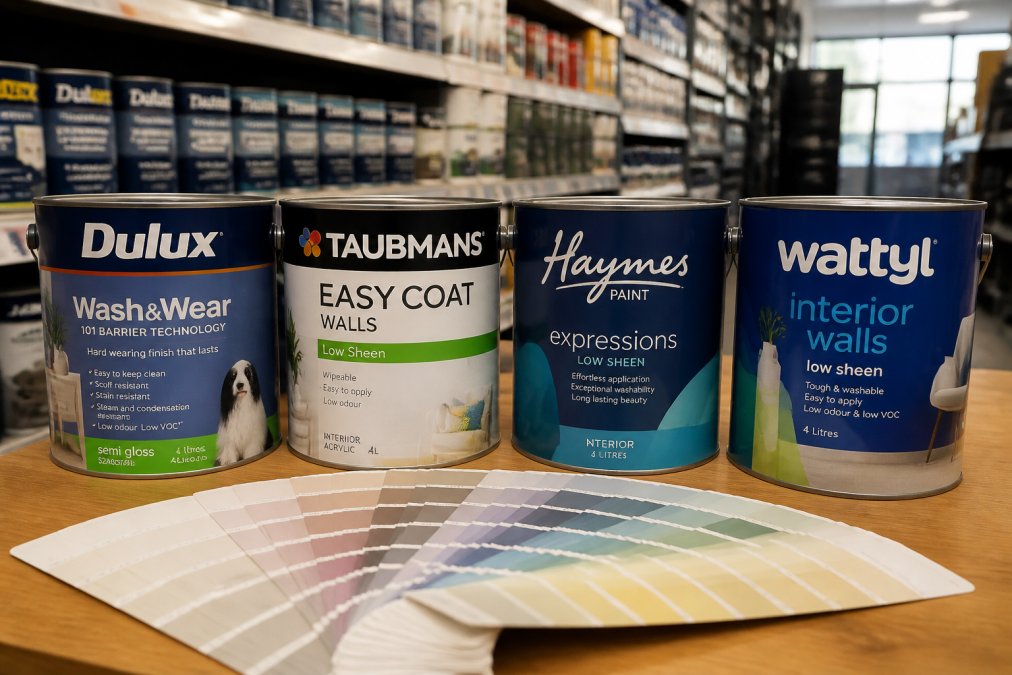
| Brand | Key Strength | VOC Profile | Best For |
|---|---|---|---|
| Dulux | Colour range and pigment quality | Low to ultra-low options | Residential and colour-critical work |
| Taubmans | Coverage value | Low VOC ranges available | Budget-conscious renovators |
| Haymes Paint | Australian-made, eco credentials | Strong low-VOC offering | Eco-conscious homeowners |
| Wattyl | Trade durability | Varies by product line | High-traffic and commercial interiors |
Dulux
Dulux is the most widely recognised interior paint brand and earns that position on merit. Its Wash & Wear range is a benchmark product for residential interiors: good scrub resistance, a satin sheen that reads well under varying light conditions, and a tinting system that produces consistent colour results across batches. The Dulux Aquanamel range extends into semi-gloss applications for trims and wet areas, offering strong adhesion and a hard film that tolerates frequent cleaning.
Where Dulux falls short is price. The premium ranges sit at the higher end of the market. For straightforward residential work, the mid-range Dulux products represent good value.
Best for: Homeowners who want proven colour accuracy and broad product availability.
Taubmans
Taubmans competes directly with Dulux on coverage claims and undercuts it on price. The Endure range is the brand’s flagship interior product, marketed on its durability and washability credentials. In practice, it performs well on prepared surfaces and handles standard household cleaning without issue.
The brand’s strength is accessibility. Taubmans products are widely stocked, the tinting system is straightforward, and the coverage rate on smooth surfaces is competitive. The honest limitation is that Taubmans’ top-tier products don’t quite match Dulux or Haymes for pigment density on difficult substrates.
Best for: Renovators working across large areas who want reliable performance at a lower cost per litre.
Haymes Paint
Haymes is Australian-made and owned, manufactured in Ballarat, and has built a genuine reputation for quality. The brand’s low-VOC credentials are among the strongest in the market, making it a serious option for households with sensitivity concerns or projects in poorly ventilated spaces.
According to Haymes Paint’s product information, several of their interior ranges carry ultra-low VOC ratings, meeting the standards set by the Green Building Council of Australia’s rating tools for indoor environment quality. The Haymes Breathe Easy range is formulated specifically for low-odour application, which makes it practical for bedrooms, nurseries, and spaces where occupants can’t vacate for extended periods.
Best for: Eco-conscious homeowners, people with chemical sensitivities, and projects in occupied spaces.
Wattyl
Wattyl occupies a different niche from the other interior paint brands on this list. Its strength is in trade and commercial applications, where durability and film hardness matter more than colour range. The Wattyl I.D. Advanced range is a solid all-rounder for residential use, but the brand’s real advantage shows in high-traffic environments: hallways, stairwells, rental properties, and commercial interiors.
The limitation is a narrower colour range and less sophisticated tinting system compared to Dulux or Haymes. If colour accuracy is your priority, Wattyl isn’t the first choice.
Best for: Rental properties, commercial interiors, and high-traffic residential spaces.
How to Choose Interior Paint Finish for Every Room
Selecting the right finish is as important as selecting the right brand. The gloss level of a paint determines its sheen, its washability, and how forgiving it is of wall imperfections.
Matte and flat finishes absorb light and conceal surface irregularities well, but are the least scrub-resistant option. They suit low-traffic areas like formal dining rooms, master bedrooms, and ceilings.
Low-sheen finishes represent the most versatile choice for general living spaces, offering better washability than matte without the reflectivity that makes wall imperfections obvious. Most professional painters default to low-sheen for living rooms, bedrooms, and hallways.
Satin finishes have a soft sheen that reads well in natural and artificial light. They clean more easily than low-sheen products and suit family rooms, children’s bedrooms, and dining areas.
Semi-gloss and gloss finishes are the most durable and washable options. Their reflectivity makes surface preparation critical. Reserve semi-gloss for trims, doors, and wet areas; full gloss is rarely used on walls in modern interiors.
| Finish | Washability | Best Rooms | Surface Flaws |
|---|---|---|---|
| Matte / Flat | Low | Ceilings, formal rooms | Conceals well |
| Low-sheen | Moderate | Living areas, bedrooms | Conceals moderately |
| Satin | Good | Family rooms, hallways | Shows some flaws |
| Semi-gloss | High | Wet areas, trims | Shows flaws clearly |
| Gloss | Very high | Doors, trims only | Shows all flaws |
Low VOC Interior Paint Options Worth Knowing
VOC stands for volatile organic compound. VOCs are chemicals that off-gas from paint during and after application, contributing to indoor air quality issues. The National Health and Medical Research Council guidance on indoor air quality identifies VOC exposure as a relevant consideration for indoor environments, particularly in poorly ventilated spaces.
Most modern waterborne acrylic interior paints have significantly lower VOC content than older solvent-based formulations. However, "low VOC" is not a standardised term across the industry. Ultra-low VOC products typically contain less than 5 grams per litre of VOCs; standard low-VOC products sit below 50 g/L.
For DIYers working in confined spaces without mechanical ventilation, low-VOC and zero-VOC options are a practical health measure. Haymes Breathe Easy and the Dulux Envirowash range are the most readily available options at the lower end of the VOC spectrum.
“Water-based” does not automatically mean “low VOC.” Some waterborne paints still contain significant VOC levels from tinting pigments added at point of sale. Always check the VOC rating after tinting, not just the base product.
How to Prepare Walls for Painting Before You Open a Tin
Wall preparation is where most DIY paint jobs fail. A paint product can only perform as well as the surface beneath it allows.
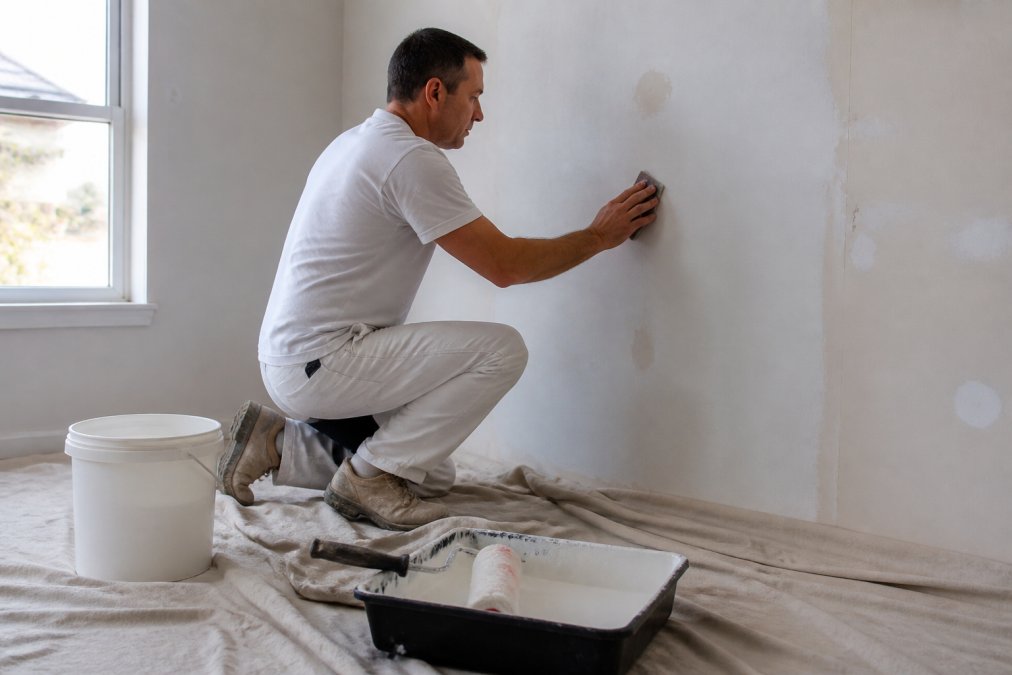
The preparation sequence for interior walls follows a consistent logic:
- Clean the surface. Remove grease, dust, and contaminants with a sugar soap solution. Paint will not bond to a greasy substrate.
- Repair damage. Fill cracks, holes, and dents with a suitable filler compound. Allow it to cure fully before sanding.
- Sand smooth. Sand filled areas and any glossy existing surfaces with fine-grit sandpaper. This creates a mechanical key for the new paint to bond to.
- Apply primer or undercoat. New plaster, bare timber, and surfaces with significant colour changes all benefit from a primer coat.
- Check drying time before recoating. Allow the primer to reach the manufacturer’s specified drying time before applying the topcoat.
Preparation time scales with the condition of the existing surface. A well-maintained wall in good condition needs less work than a surface with patchy old paint, moisture damage, or multiple layers of incompatible coatings.
Climate Performance and Surface Compatibility for Interior Paint Brands
Waterborne acrylic paints are sensitive to temperature during application. Most manufacturers specify a minimum application temperature of around 10°C and a maximum of 35°C. Painting in conditions outside these ranges affects film formation, drying time, and ultimately, the durability of the cured coating.
Surface compatibility is a separate consideration. Not every interior paint product bonds equally well to every substrate:
- New plaster: Requires a sealer or primer coat before topcoats.
- Previously painted surfaces: Compatibility depends on what’s already there. Applying a water-based product over an oil-based paint without proper preparation leads to adhesion failure.
- Fibre cement sheet: Requires a specific primer formulated for fibre cement to prevent moisture ingress.
- Timber: Knots and resinous timber require a shellac-based sealer before painting to prevent bleed-through.
Heritage homes present particular challenges. Older substrates, lead-based paint layers, and lime plaster all require careful assessment before selecting a product. Matching the flexibility of the new coating to the movement characteristics of the substrate is critical in older buildings.
Premium vs Budget Paint Ranges: What You Actually Get
The price gap between premium and budget interior paint ranges is real, and so are the performance differences.
Premium interior paint ranges, such as Dulux Wash & Wear Ultra and Haymes Solashield, invest in higher pigment density, better resin quality, and more sophisticated additive packages. The practical results are better opacity in fewer coats, longer service life before repainting is needed, and finishes that maintain their appearance under regular cleaning. For a family home where walls take daily wear, the long-term cost of a premium product is often lower than repainting sooner with a budget option.
Budget ranges cut costs primarily through lower pigment loading and simpler resin systems. They perform adequately on well-prepared surfaces in low-traffic rooms but show wear faster and are less forgiving of surface imperfections.
The most common mistake is applying a budget paint to a poorly prepared surface, then attributing the poor result to the product rather than the preparation. Preparation quality and paint quality are both non-negotiable.
For high-traffic areas, wet rooms, and surfaces that will be cleaned regularly, invest in a premium product. For low-traffic rooms in good condition, a mid-range option from a reputable brand is often sufficient.
As a professional painting service, the We Do Painting team recommends specifying the paint product before finalising a project budget. The cost difference between a budget and premium tin is modest compared to the labour cost of an additional coat or an early repaint.
For guidance on selecting the right product for your specific substrate and conditions, the Paint and Coatings Association of Australia resources provides technical information on product categories and application standards.
Frequently Asked Questions
What are the top interior paint brands in Australia?
Dulux, Taubmans, Haymes, and Wattyl are consistently regarded as the leading interior paint brands. Each offers a range of finishes from matte to semi-gloss, with varying VOC content, coverage rates, and price points. Haymes is Australian-owned and manufactured, which appeals to buyers focused on locally tested formulations. Dulux and Taubmans have the widest retail availability, while Wattyl is often preferred for trade applications requiring strong adhesion and durability.
Is Dulux or Taubmans better for interior walls?
Both perform well on interior walls, but the right choice depends on your priorities. Dulux tends to offer slightly higher pigment density and a broader tinting range, which suits feature walls and deep colours. Taubmans is well regarded for its washability and stain resistance, making it a practical pick for high-traffic areas like hallways and family rooms. A professional painter can advise which product suits your specific substrate and finish preference before you commit to a brand.
Is Haymes or Dulux better for professional finishes?
Haymes is often preferred by professional painters for its smooth application, minimal brush marks, and strong colour retention over time. Its waterborne acrylic formulations are designed to perform in Australian conditions. Dulux remains the dominant trade brand due to its consistent quality control and wide product range. The best choice depends on the substrate, the gloss level required, and the recoat interval that suits your project timeline. Both brands produce results that hold up well when applied over properly prepared surfaces.
Does Australian-made paint perform better in local climates?
Locally manufactured paints are formulated with Australian temperature ranges, humidity levels, and UV exposure in mind. Brands like Haymes, which produce their paint domestically, test their formulations against conditions that imported or globally standardised products may not account for. This can translate to better colour retention, reduced chalking, and more stable adhesion on substrates that expand and contract with seasonal temperature swings. It is a genuine performance consideration, not just a marketing point.
Which interior paint finish should I use in a bathroom or kitchen?
Semi-gloss or satin finishes are the standard recommendation for bathrooms and kitchens because they resist moisture, are easy to wipe down, and hold up against steam and splashes. Matte and low-sheen finishes absorb moisture more readily and are harder to clean without leaving marks. Look for a waterborne acrylic with a high scrub resistance rating. Some brands offer specific kitchen and bathroom formulations with added mould inhibitors, which are worth choosing over a standard interior paint in wet areas.
Choosing between interior paint brands is genuinely complex when you account for finish, VOC content, surface compatibility, and climate conditions. We Do Painting takes the guesswork out of that process. Our team specifies the right product for each surface and condition, handles preparation thoroughly, and delivers projects on time and within budget. Request a quote from We Do Painting and get a professional recommendation tailored to your specific walls, rooms, and renovation goals.
This article was written using GrandRanker